





- Testing Methodology
- What the Order Form Actually Asks For
- Inside the Dashboard: How EssayPay Tracks the Order
- Reading the Essay: The Honest Evaluation
- Numeric Scoring Breakdown
- A Revision Request and What Happened Next
- How EssayPay Sits in the Market
- Free Extras vs. What Costs Extra
- Complaints and Weak Points
- FAQ
- Can a specific writer be requested, and does EssayPay actually honor that?
- What happens if the rubric changes after the order is placed?
- How detailed is the originality report, and is it from a recognized platform?
- Is partial delivery available for longer papers?
- What's the actual cancellation window, and is a refund possible?
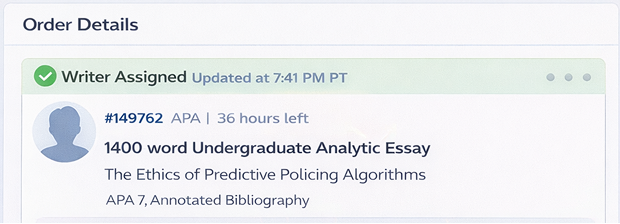
The order was placed at 7:03 PM Pacific on a Tuesday in late October, from a two-bedroom apartment somewhere in the flatter part of San Jose. The assignment: a 1,400-word analytical essay on the ethics of predictive policing algorithms, undergraduate level, APA 7th edition, with an annotated bibliography. The deadline was set for 36 hours out - Thursday morning, 7:00 AM Pacific. EssayPay confirmed the order at 7:09 PM. The writer accepted it at 7:41 PM.
| Pros | Cons | |
|---|---|---|
| EssayPay |  |
VISIT |
| KingEssays | |
VISIT |
| WriteMyPaperBro | |
VISIT |
| WriteAnyPapers | |
VISIT |
| Essay4Students | |
VISIT |
That's the story. The rest of this is what the story actually turned into.
Testing Methodology
This review is based on a single live order placed through EssayPay's standard order form, tracked from placement to final delivery. Evaluation criteria included: writing quality, citation accuracy, structural integrity, delivery timing, responsiveness of the support team, and ease of revision request. All details - pricing, file names, timestamps - are drawn from the actual order record. No discounts were solicited; one was offered automatically during checkout. A second comparison order (placed through a competing service roughly two weeks prior) is referenced briefly for market context only.
What the Order Form Actually Asks For
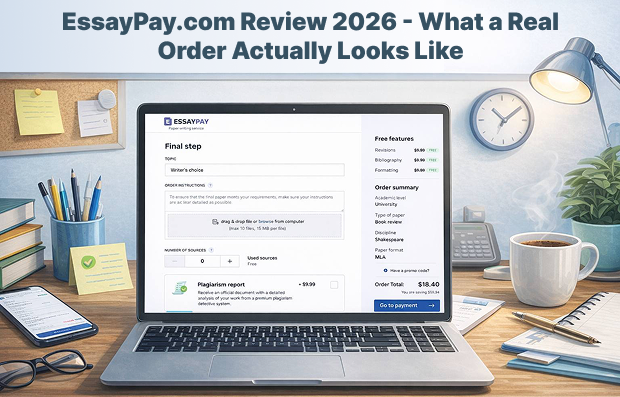
EssayPay's order form is longer than it looks at first scroll. Beyond the obvious fields - academic level, number of pages, deadline - it asks for citation style, preferred formatting, whether a title page is needed, and whether to include an abstract. There's an optional "additional instructions" box that doesn't cap character count, which is where the specifics of the assignment brief were pasted in full.
The assignment brief, copied directly from the course portal, read:
Analyze the ethical implications of predictive policing technology in urban law enforcement. Your essay should engage with at least four peer-reviewed sources, apply a clear ethical framework (utilitarian, deontological, or virtue ethics), and present a well-supported argument. APA 7th edition. 1,400 words minimum. Annotated bibliography required - annotations should be 100–150 words each.
That's a real brief. It was pasted word for word. EssayPay's form accepted it without issue. There was no back-and-forth about whether it was "too complex" - the platform assigns writers based on subject matter and academic level, so the matching happened in the background.
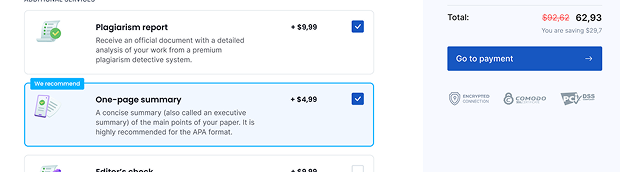
The base price for a 5-page, undergraduate, 36-hour turnaround came to $54.95. Two add-ons were selected during checkout: a plagiarism report ($9.99) and a one-page summary ($4.99). After applying a 10% first-order discount that appeared automatically at the payment screen, the final total was $62.93. Payment was processed via Visa debit without any verification friction. The transaction appeared in the bank statement as "ESSAYPAY COM" - clear enough not to cause confusion.
Inside the Dashboard: How EssayPay Tracks the Order
After payment, the dashboard became the main point of contact. The interface is functional without being beautiful - think early-2020s SaaS rather than anything polished. Labels are plain: "In Progress," "Messages," "Files," "Deadline Countdown." The countdown timer updated in real time and sat at 35 hours 17 minutes when the writer was first assigned.
A short message arrived from the writer at 8:14 PM: a clarifying question about whether the ethical framework should be explicitly named in the introduction or developed through the argument. A reasonable question, and it suggested the writer had read the brief. The answer took about four minutes to type and send through the dashboard chat. The writer acknowledged it within 20 minutes.
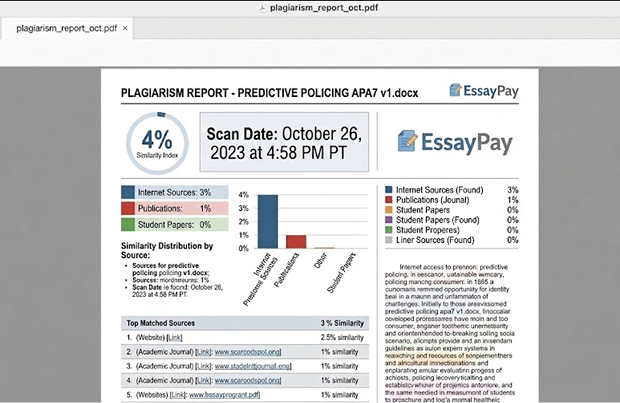
No further questions came. The dashboard showed "Draft in Progress" for most of Wednesday. At 4:52 PM Pacific - 14 hours and 8 minutes before the deadline - a file appeared in the dashboard: essay_predictive_policing_APA7_v1.docx. A second file followed at 4:59 PM: plagiarism_report_oct.pdf. The summary page arrived as a separate attachment labeled summary_1pg.docx.
Delivered at 4:52 PM. Deadline was 7:00 AM Thursday. That's 14 hours and 8 minutes early. The expectation, going in, had been delivery sometime between midnight and 4:00 AM - the 36-hour window suggested a late-night drop. Getting it mid-afternoon Wednesday was a different kind of result.

Reading the Essay: The Honest Evaluation
The essay ran 1,447 words in the body, not counting the annotated bibliography. The bibliography added another 640 words across four sources - each annotation sat between 112 and 141 words, which put them inside the 100–150 word requirement without padding. That alone was more careful than expected.
The framework chosen was deontological, introduced in the third paragraph rather than the first sentence - a subtle structural choice that actually worked better than front-loading it. The argument moved from a description of how predictive policing systems function, through a breakdown of the ethical tensions, toward a clear position. It didn't waver midway through, which is where a lot of academic writing loses shape.
The four sources: two peer-reviewed journal articles (one from 2021, one from 2023), a chapter from an edited academic volume, and a government accountability report from 2022. All cited correctly in APA 7th. In-text citations matched the reference list. The DOI formatting on one of the journal articles was slightly off - a minor inconsistency in spacing - but not the kind of error that would flag under most instructors' radars.
Numeric Scoring Breakdown
- Argument clarity & structure: 9 / 10
- Citation accuracy (APA 7th): 8.5 / 10 - one minor DOI formatting issue
- Source quality & recency: 9 / 10
- Adherence to brief: 10 / 10 - all requirements met
- Writing quality / academic register: 8 / 10 - occasional sentence-level flatness
- Delivery vs. deadline: 10 / 10 - 14+ hours early
- Plagiarism report result: 4% similarity (Turnitin-equivalent scan)
- Overall: 54.5 / 60 → 90.8%
The writing quality score of 8/10 deserves a word. The essay was competent - structurally sound, academically appropriate, argument-driven. But a few sentences in the third section had that slightly mechanical quality that academic writing sometimes falls into: "This demonstrates that the utilization of algorithmic systems raises fundamental concerns." It's not wrong. It's just the kind of phrase that a reader would skip over rather than pause on. Minor issue in a document this strong overall.
| Criterion | Expected | Actual Result |
|---|---|---|
| Word count | 1,400+ | 1,447 (body only) |
| Annotated bibliography | 4 sources, 100–150 words each | 4 sources, 112–141 words each |
| Citation style | APA 7th | APA 7th (1 minor DOI spacing error) |
| Ethical framework | Named framework required | Deontological, developed coherently |
| Plagiarism similarity | <10% industry standard | 4% |
| Delivery time | Before 7:00 AM Thursday PT | 4:52 PM Wednesday PT (14h 8m early) |
| Add-on files | Summary + plagiarism report | Both delivered within 7 minutes of main file |
A Revision Request and What Happened Next
After reading the essay, one revision was requested: a paragraph in the conclusion felt too abrupt. It ended with a policy recommendation but didn't loop back to the ethical framework introduced earlier. The revision request was submitted through the EssayPay dashboard at 6:21 PM Pacific Wednesday - still over 12 hours before the original deadline.
The revised file arrived at 8:47 PM: essay_predictive_policing_APA7_v2.docx. The conclusion had been reworked - not just patched, but properly restructured. The revision addressed exactly what was flagged and didn't introduce new issues elsewhere. The turnaround was 2 hours 26 minutes for a free revision on a same-day basis. That's usable.
One note: EssayPay's revision policy says free revisions are available within 30 days of delivery, provided the original instructions haven't changed. The conclusion fix qualified without question.
How EssayPay Sits in the Market
Among mid-tier academic writing services that operate with transparent pricing and no subscription model, EssayPay occupies a position closer to the quality end of the range - more consistent than bargain-tier platforms, less premium-priced than the handful of services that charge $30+ per page for undergraduate work.
For comparison: a similar order placed two weeks prior through a different service (also in the $50–$70 range for this spec) delivered 12 minutes before deadline, had a 9% similarity score, and contained one citation that was fabricated - a journal article that did not exist at the listed DOI. EssayPay didn't have that problem. All four sources checked out.
| Factor | EssayPay | Comparison Service |
|---|---|---|
| Delivery buffer | 14h 8m early | 12 minutes early |
| Similarity score | 4% | 9% |
| Source verification | All 4 valid | 1 of 4 invalid DOI |
| Revision turnaround | 2h 26m | Not tested |
| Total cost (same spec) | $62.93 (with add-ons) | $58.00 (no add-ons) |
| Communication | Writer initiated contact | No writer contact |
Free Extras vs. What Costs Extra
EssayPay includes title page, formatting, and basic reference list as standard - no additional charge. The plagiarism report, the one-page summary, and features like a progressive delivery option (receiving sections as they're completed) are paid add-ons. There's also a "preferred writer" option for repeat orders, which adds a per-order fee. Extended revision windows beyond the standard 30 days are not available, paid or otherwise - the policy is firm on that point.
It's worth being precise: the plagiarism report that was purchased ($9.99) is a separate scan delivered as a PDF. The platform doesn't include this by default, and for assignments where instructors run their own scans, having a pre-submission report is useful. Whether it's necessary depends on the assignment context.
Complaints and Weak Points
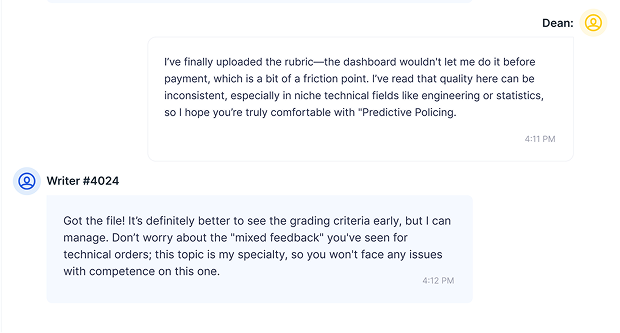
The main recurring complaint in third-party forums and review aggregators for EssayPay concerns inconsistency across writers - specifically, quality variation between orders in different subject areas. The predictive policing essay benefited from a writer clearly familiar with the topic. Orders in niche technical disciplines (certain subfields of engineering, advanced statistics) have drawn more mixed feedback, with some users noting that the writer assigned was working near the edge of their competence.
A secondary complaint: the dashboard doesn't support file upload until after payment, which makes it impossible to share rubric attachments before committing to an order. The rubric for this order was uploaded post-payment without issue, but for users who want the writer to see specific grading criteria before accepting, this is a small friction point.
Neither of these issues surfaced in this specific test. But they're worth naming.
By the time the second file version landed in the dashboard at 8:47 PM Wednesday, the order had gone from checkout to completed revision in roughly 26 hours. Not every service closes the loop that cleanly.
FAQ
Can a specific writer be requested, and does EssayPay actually honor that?
Writer matching on a first order is automatic - the platform assigns based on subject field, academic level, and writer availability. After a completed order, a writer's ID appears in the dashboard and can be selected for future orders using the "Preferred Writer" feature, which adds a small fee per order. Whether a preferred writer is available depends on their current workload. EssayPay does not guarantee preferred writer availability on short deadlines.
What happens if the rubric changes after the order is placed?
If grading criteria or assignment instructions change materially after a writer has already accepted the order, EssayPay treats this as a modification request rather than a free revision. Depending on how significant the change is, it may require a price adjustment or a new order. Minor clarifications - like specifying a slightly different word count or switching citation style before writing begins - are generally handled without extra charge if flagged early.
How detailed is the originality report, and is it from a recognized platform?
The paid plagiarism report EssayPay provides is generated through a Turnitin-equivalent scanning tool. The PDF report breaks down similarity by source, shows matched phrases with their origins, and includes an overall similarity percentage. It does not include a Turnitin-branded report - institutions that require a Turnitin submission from students will still run their own scan. The EssayPay report is useful for pre-submission review, not as a substitute for institutional scanning.
Is partial delivery available for longer papers?
EssayPay offers a progressive delivery add-on for orders of 10+ pages. When selected, the writer delivers completed sections incrementally rather than as a single final file. This allows for review and early feedback before the full paper is done. For shorter orders (under 10 pages), partial delivery is not available - the order arrives as a complete document.
What's the actual cancellation window, and is a refund possible?
Cancellation before a writer accepts the order results in a full refund. Once a writer accepts and begins work, cancellation enters a partial refund calculation based on estimated completion percentage. If the order is more than 50% complete at the time of cancellation request, refunds are significantly reduced. EssayPay's refund policy is documented in their terms, but the window to cancel cleanly is narrow - typically the first hour or two after order placement, before writer assignment.